.jpg)
India's share of 2015 emerging market allocations will be driven by FII perceptions on likely growth and reform.


Sarabjit Singh Khalsa, son of Beant Singh, one of the two assassins of Prime Minister Indira Gandhi, joined the Bahujan Samaj Party in Fatehgarh Sahib in Punjab on Sunday.
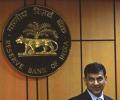
The central bank operationalised these special windows on September 4 to prop the rupee which had fallen close to 30 per cent between April and August.
So far, India has attracted over $20 billion in the debt segment, thanks to the rate differential.
Slowing economy, election-related uncertainty and tighter monetary conditions pose risks for Indian markets and the BSE index, Sensex, is likely to hover around 20,250 by the end of this year.

RBI would get the comfort of meeting its 8 per cent January Consumer Price Index-based inflation target, BofA-ML said, adding that 'we expect the RBI to cut 75 bp in 2015 from February with inflation on course to 6 per cent in January 2016'.

The partially convertible rupee closed at 61.2350/2450 per dollar compared with 61.31/32 on Tuesday.

History would indicate that a recession is not that far off.
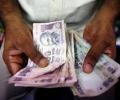
The rupee appreciated by 10 paise to close at a nearly six-week high of 60.29 against the US dollar in the previous session tracking a solid rally in local shares and continued dollar selling by exporters and some banks.
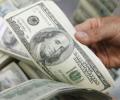
A delay in US Federal Reserve's quantitative easing tapering, coupled with better-than-expected September quarter earnings, ensured FIIs kept foreign money flowing into Indian equities.

'Demonetisation will push India onto a higher growth path after a temporary dip.'

'The recent US jobs report has eased fears of a hike in the Fed meeting.'

In a surprise decision, Ankita was left out of the financial assistance scheme despite being India's top-ranked player. The Sports Ministry included second-highest ranked player Karman Kaur Thandi and Prarthana Thombare apart from seasoned Sania Mirza for Rs 50,000 monthly allowance.
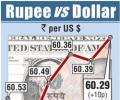
Forex dealers said besides increased selling of the American currency by exporters and banks, a higher opening in the domestic equity market and the dollar's weakness against other currencies overseas supported the rupee.
China's CSI300 stock index shed 1.1 per cent, hitting a five-week low, while shares of Hong Kong-listed Chinese companies sagged 0.9 per cent.

'The market movement will be largely driven by earnings growth.'
.jpg)
As many as nine respondents said RBI would hold the repo rate at 8% till March-end, 2015
In worldwide trade, the US dollar retreated from its recent multi-year highs to trade subdued against major rival currencies

As FY20 Budget fiscal measures need to be better understood, a reversal of the stance back to neutral will allow MPC flexibility to respond to incoming data.

US interest rate normalisation policy is likely to keep global FX markets volatile.

'We are overweight on India, as it is one of the best in emerging markets (EMs)'

Sectorally, metal and banking stocks rallied the most, while FMCG and realty stocks came under selling pressure.

The rupee's plunging to record level and a sharp fall in the equity market are knee-jerk investor reactions to the US Federal Reserve's saying the it will slow down bond-buying programme in view of improving American economy.
India has always been a good bet in relative terms during crises/turbulent times in emerging markets (EMs).
The S&P BSE Midcap and the S&P BSE Smallcap indices under-performed to lose 0.8% and 1.6%

As global markets near all-time highs driven by liquidity, Marc Faber suggests most asset prices worldwide are inflated.

The central bank had revised its inflation forecast significantly downward in the last policy

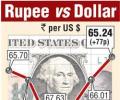
After hitting a record low of 68.85 to the dollar last week, a Reuters poll suggests the rupee will stabilise at 66 to the dollar by the end of September, while technical charts also point to a period of relative calm.

India is likely to attract increasing notice from global investors.

The Reserve Bank of India kept interest rates on hold at 7.50 per cent.

The second half of June could be driven more or less by technical factors triggered by news flow from Greece, the US Federal Reserve and the monsoon. The technical picture seems bearish as of now, says Devangshu Datta.

Conor McGregor said on Tuesday he was retiring from the sport, five months after losing to Khabib Nurmagomedov in a controversial title fight
